


Lessons from Brussels: Reflections on the Young Diplomats Forum 2025
- Sep 8, 2025
- 6 min read
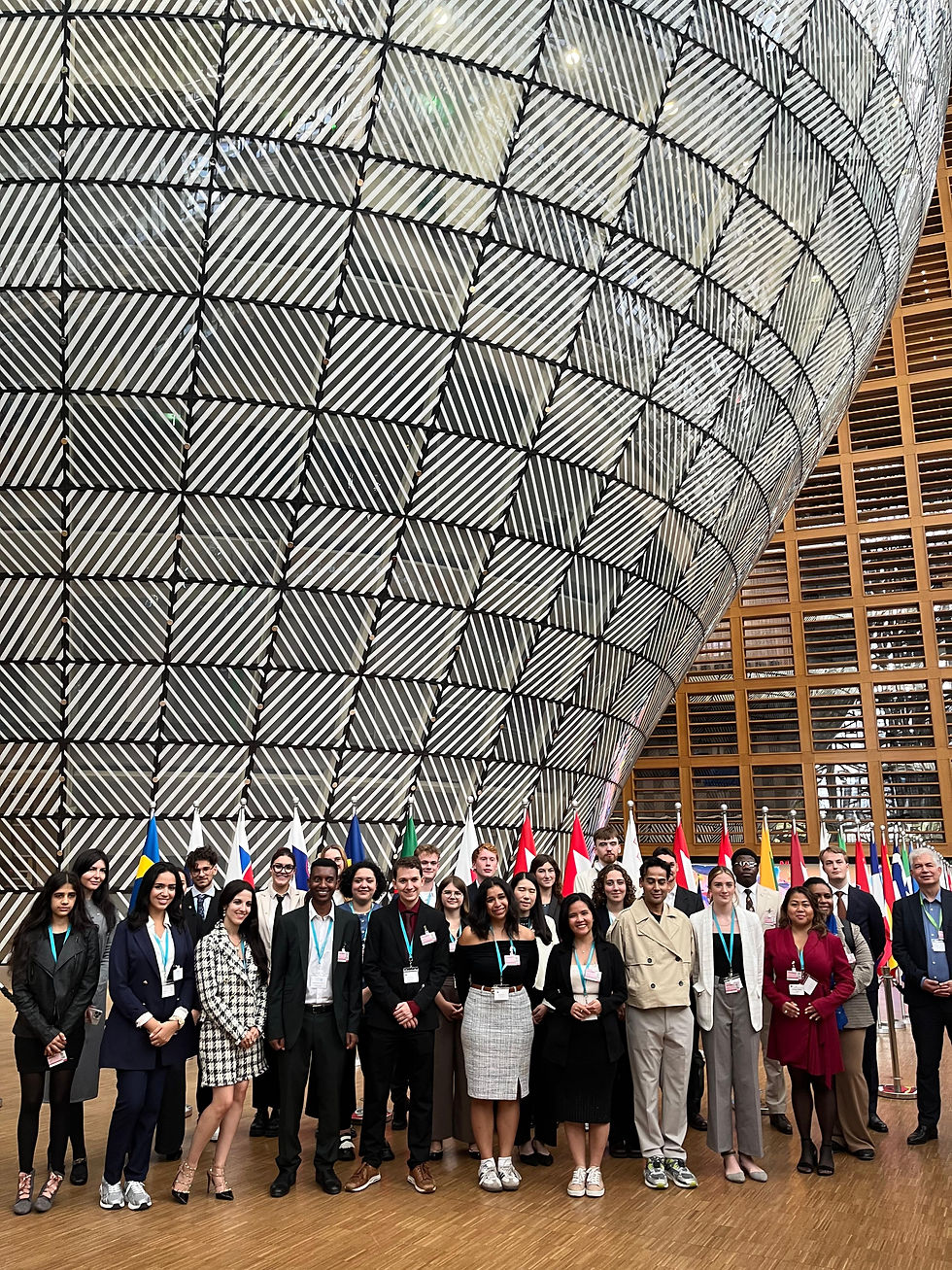
Last week, I had the privilege of participating in the 22nd Edition of the Young Diplomats Forum (YDF) in Brussels. For five days, I was immersed in the world of European diplomacy, joining participants from across the globe in discussions that ranged from the future of artificial intelligence to the nuances of transatlantic trade.
The program was dense, ambitious, and inspiring. We moved between institutions that usually make headlines from a distance — the European Parliament, the Council of the EU, the Committee of the Regions — and entered the spaces where the daily work of governance takes place. Alongside institutional visits, we engaged in panels, workshops, and a collaborative policy exercise that demanded we put theory into practice.
What follows are my reflections on the week, woven together from my notes, our policy brief, and the many conversations that challenged me to rethink what diplomacy looks like in the 21st century.
Technology and Diplomacy: “If You Don’t Have the Knowledge, It Appears to Be Like Magic”
We began with a keynote from Sven Verstrepen, Science and Technology Counselor at Flanders Investment and Trade. His talk was titled “The Marriage between Diplomacy and Innovation,” and it was as much about history as about the present.
“Why should diplomats care about technology?” he asked. His answer was simple yet powerful: “There is an art of putting applied scientific knowledge into practice — if you don’t have the knowledge it appears to be like magic.”
Verstrepen reminded us that diplomacy and technology have always been intertwined. He offered a rapid-fire journey through history: Mesopotamian encryption in 1500 BCE, the Byzantine Empire’s guarded recipe for Greek fire — “so encrypted that even today we don’t know the exact formula” — the Murano glassmakers of Venice who were forbidden to leave the island under penalty of death, and the scientific race of the 20th century that brought us both the atomic bomb and the space station.
He highlighted how states have dealt with technology competitively — through secrecy, monopolies, compartmentalization, and export controls — but also collaboratively, through treaties, scientific networks, and public-private partnerships. The message was clear: managing knowledge is as central to diplomacy today as it was a thousand years ago.
For Flanders, which accounts for 82.2% of Belgian exports and invests 3.5% of GDP in R&D (higher than both EU and OECD averages), innovation is a diplomatic tool in its own right. In a global economy shaped by AI, semiconductors, and military technology, regional actors like Flanders are as relevant to the future of diplomacy as nation-states.
Diplomacy in the 21st Century: Voices of Multipolarity
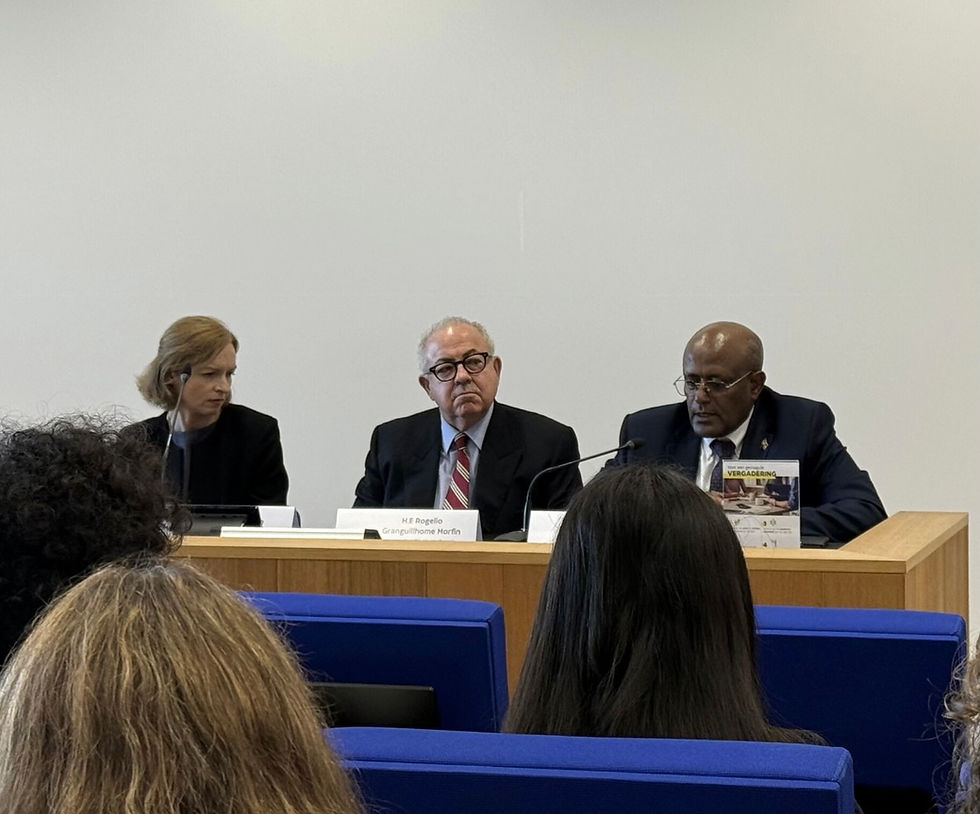
The opening panel that followed introduced us to ambassadors grappling with today’s fractured world order.
H.E. Eshete Tilahun, Ambassador of Ethiopia, spoke about the “weakening of multilateralism and growing populism, extremism, nationalism in policy networks.” He described the present as a moment of both “hope and despair,” and suggested that regional organizations — from the African Union to ASEAN — were increasingly the building blocks of diplomacy.
H.E. Jennifer Troup, Ambassador of New Zealand, reminded us that diplomacy is not only state-to-state. “It’s people, not governments, that keep the links alive between countries,” she said. She cited New Zealand’s reliance on Belgian vaccine production during the pandemic and noted how non-state actors are reshaping international relations, from farmers’ associations to student movements.
H.E. Rogelio Morfin, Ambassador of Mexico, added a North American perspective: “Globalization is being rewritten at the crossroads of the Global North and Global South.” He argued that “regionalism is globalization’s evolution,” pointing to Mexico’s role in reconfigured North American supply chains.
These interventions framed the week: the challenges of multipolarity, the need for resilience in global trade, and the reality that diplomacy is increasingly conducted by regions, civil society, and non-state actors.
My Favorite Visits: Flemish Parliament and the Committee of the Regions
While every institution we visited expanded my understanding of European governance, two stood out as particularly meaningful: the Flemish Parliament and the Committee of the Regions.
The Flemish Parliament
On our fourth day, we visited the Flemish Parliament. The experience was a revelation. Belgium’s federal system grants significant powers to its regions, and the Flemish Parliament is more than a symbolic assembly — it is a legislative body shaping education, foreign policy, and trade.
Hearing from Flemish officials, I was struck by the way regional identity is not in conflict with global outlook. Instead, the Flemish Parliament embodies how subnational entities can act as diplomatic actors in their own right. Just as Flanders has built a global export network, its parliament operates at the intersection of local governance and international ambition.
This visit reminded me that the future of diplomacy is not only vertical — negotiated between heads of state — but horizontal, extending across regions and communities.
The Committee of the Regions
The European Committee of the Regions (CoR) was equally impressive. Established by the Maastricht Treaty, the CoR ensures that cities and regions have a say in EU policymaking.
One official explained the logic simply: “Around 70% of EU legislation is implemented by local and regional administrations, not by member states.”
Without regional voices, EU law would risk being detached from the realities of implementation.
The CoR has 329 members, appointed by member states, who meet six times a year. They draft about 60 opinions annually on issues like agriculture, transport, and energy. “Our job is to make sure both the Council and the Parliament know what the regions stand for,” one administrator told us.
What struck me most was the democratic impulse behind the CoR. Even in a vast supranational system, the EU has built space for mayors, regional ministers, and local representatives to feed into lawmaking. In an era when the EU is often criticized for being distant, the CoR is proof that governance can be both global and local.
Policy in Action: Our Brief on Transatlantic Trade
Beyond listening and learning, the Forum required us to act. In policy development groups, we produced briefs on pressing global issues. My team was assigned trade policy, with a focus on the future of transatlantic trade relations post-IRA and CBAM.
Our starting point was clear: both the U.S. Inflation Reduction Act (IRA) and the EU’s Carbon Border Adjustment Mechanism (CBAM) are ambitious climate-oriented policies, but they risk undermining transatlantic unity. As we wrote:
“The challenge lies in reconciling climate ambition with fair trade. Instead of presenting a unified Western front on climate leadership, the US and EU appear to be competing — sending mixed signals to the rest of the world and reinforcing nationalist, protectionist tendencies.”
We considered three options:
Transatlantic alignment on green standards, negotiating a joint framework for carbon accounting.
Linking CBAM revenues to climate solidarity, directing funds to developing nations for adaptation and infrastructure.
Parallel subsidy pathways, with the EU experimenting with subsidies and the U.S. considering border mechanisms.
Our recommendation was Option 2: “tying CBAM revenues to international climate solidarity. This approach fosters transatlantic unity, protects vulnerable economies, and strengthens the legitimacy of green trade policy.”
The presentation was challenging but rewarding. Standing before peers and mentors, we argued that trade and climate cannot be addressed in silos. Cooperation, not competition, must define the transatlantic relationship.
Takeaways: A Capital of Ideas
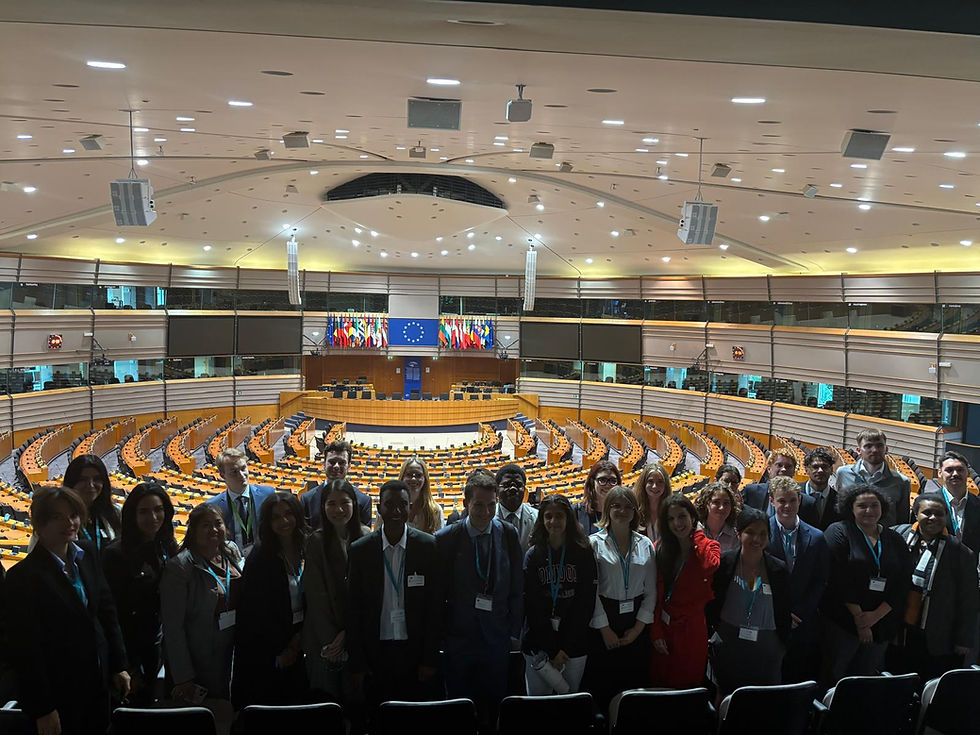
The Young Diplomats Forum was not only a professional milestone but also a deeply personal learning experience.
From Verstrepen’s reminder that technology without understanding is “like magic,” to Ambassador Troup’s insistence that “diplomacy is people, not governments,” to the Committee of the Regions’ claim that “70% of what is decided in Brussels is implemented locally,” the week was filled with insights that will shape how I think about international relations.
The Flemish Parliament and the Committee of the Regions stood out because they revealed an overlooked truth: diplomacy is not confined to grand summits or foreign ministries. It is woven into the daily practices of regions, cities, and local leaders.
Brussels, with its 75,000 diplomats and countless institutions, could easily feel overwhelming. Yet last week, it became something else entirely: a capital of ideas, where young diplomats like myself not only observed but contributed.
As I return to my studies and future research, I carry with me a conviction that diplomacy’s future will be adaptive, inclusive, and grounded in both global ambition and local realities. The Young Diplomats Forum reminded me that the bridges we build today — between regions and states, between climate and trade, between people and institutions — will determine the world we inherit tomorrow.
Acknowledgments
I am deeply grateful to the Department of Political Science, the Menard Center for Democracy, and the Honors College for sponsoring my participation in the Young Diplomats Forum. Their generous support made this unforgettable experience possible.


Comments